The demand for artificial intelligence infrastructure is growing quickly across industries. From startups building AI tools to large enterprises running complex machine learning systems, the need for powerful computing resources has never been higher. To support this growth, NVIDIA has announced a strategic partnership with Nebius Group N.V. to build and expand a next-generation full-stack AI cloud platform.
This collaboration represents a major step toward creating advanced cloud infrastructure designed specifically for artificial intelligence workloads. As part of the agreement, NVIDIA will invest $2 billion in Nebius, highlighting its confidence in Nebius’s engineering expertise and its vision for AI-focused cloud systems.
Growing Need for AI Cloud Infrastructure
Artificial intelligence technologies are now used in many sectors, including healthcare, finance, research, and digital services. These applications require enormous computing power to train models, process large datasets, and run real-time predictions.
Traditional cloud systems were designed for general computing tasks. However, AI workloads require specialized infrastructure that can support high-performance processing and advanced data management.
Through this partnership, Nebius plans to significantly expand its AI cloud infrastructure by using NVIDIA’s accelerated computing technologies. The company aims to deploy more than 5 gigawatts of computing capacity by the year 2030, making its platform one of the largest AI-focused cloud environments available.
Development of Large-Scale AI Factories
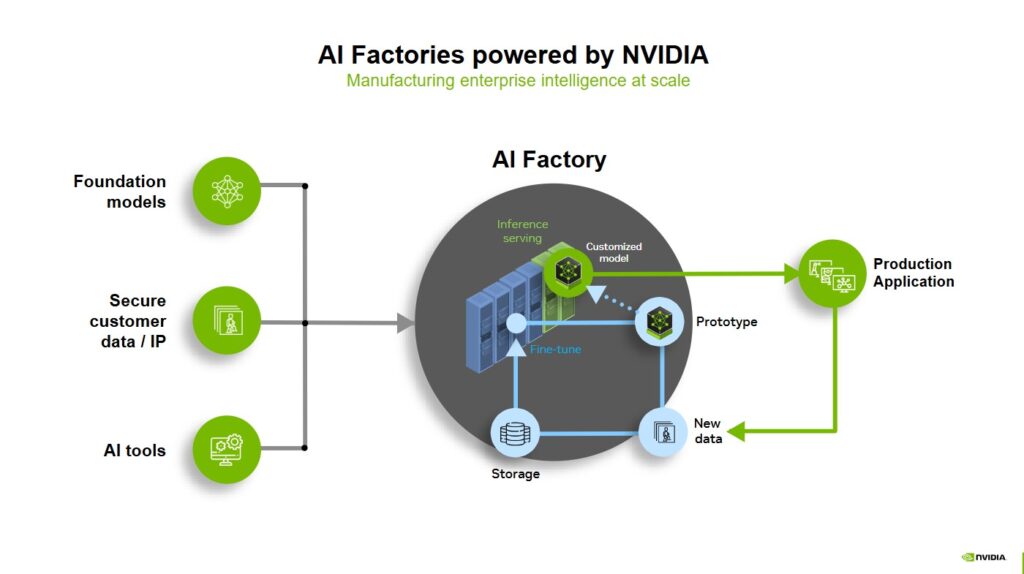
One of the key goals of the partnership is the development of AI factories. These facilities are advanced data centers built specifically to support artificial intelligence workloads such as model training, inference, and large-scale data processing.
Nebius already operates several AI infrastructure facilities and plans to expand them further with NVIDIA’s technology. These AI factories will allow developers and enterprises to build and deploy AI applications faster and more efficiently.
By combining powerful hardware with optimized software, the platform will deliver reliable and scalable computing environments for modern AI development.
Technologies Powering the AI Cloud Platform
To support this expansion, Nebius will deploy several advanced computing technologies developed by NVIDIA. These include the NVIDIA Rubin platform, NVIDIA Vera CPU, and NVIDIA BlueField storage systems.
These technologies are designed to improve computing speed, data management, and system efficiency. The partnership also includes collaboration on system architecture, engineering support, and optimized software environments for AI workloads.
In addition, advanced GPU monitoring tools will be used to maintain the health and performance of large computing fleets operating within the AI cloud platform.
AI Cloud vs Traditional Cloud Platforms

| Feature | Traditional Cloud | AI Cloud Platform |
|---|---|---|
| Infrastructure Purpose | General computing tasks | Designed specifically for AI workloads |
| Hardware | Standard CPUs | Accelerated GPUs and AI processors |
| Model Training | Slower performance | Faster and highly scalable |
| AI Inference | Limited optimization | High-speed real-time processing |
This comparison highlights why AI-focused cloud infrastructure is becoming essential for modern technology companies and developers.
The Future of AI Infrastructure
According to Jensen Huang, the rise of agentic AI is creating a new demand for advanced computing infrastructure. AI systems are becoming more intelligent and capable, which requires powerful platforms to support them.
Meanwhile, Arkady Volozh emphasized that Nebius was built as an AI-first cloud platform from the beginning. With NVIDIA’s support, the company plans to expand its infrastructure and provide powerful AI tools to developers around the world.
This partnership marks an important milestone in the evolution of AI infrastructure. As artificial intelligence continues to advance, collaborations like this will help build the computing foundation needed to support the next generation of AI innovation.